Sobre o jogo
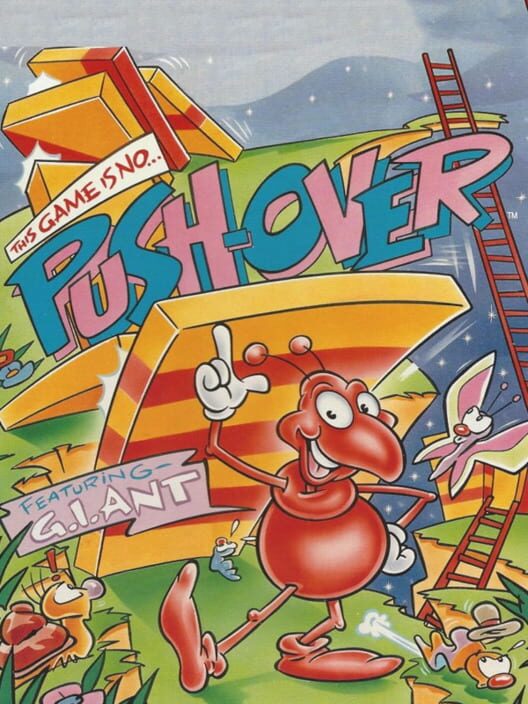
Pushover é um jogo de plataforma e quebra-cabeça desenvolvido pela Red Rat Software e publicado pela Ocean Software em 1992 para Amiga, Atari ST, DOS e Super NES. Notavelmente, o jogo foi patrocinado pelo lanche britânico Quavers da Smiths (agora pertencente à Walkers), onde a trama gira em torno do mascote da época, 'Colin Curly', que perde seus pacotes de Quavers na encosta de uma colônia de formigas gigantes. O jogador assume o controle de 'G.I. Ant', uma grande formiga soldado, com o objetivo de recuperar os Quavers resolvendo uma série de puzzles. A versão para o Super NES não possui a marca dos Quavers; em vez disso, o objetivo é recuperar pacotes de dinheiro deixados na encosta da colônia de formigas pelo Capitão Rat. O jogo é composto por 100 níveis de complexidade crescente distribuídos entre nove mundos com temas diferentes. Cada nível apresenta várias plataformas interconectadas que sustentam uma série de "dominós". O objetivo é reorganizar os dominós de forma que, com um único empurrão, todos caiam, abrindo assim a saída para o próximo nível. Existem 11 tipos diferentes de dominós, identificados por padrões vermelhos e amarelos, cada um com ações distintas. O jogador controla o G.I. Ant, que pode mover certos dominós carregando-os um por um. Vários fatores podem levar ao fracasso na conclusão de um nível. Além de derrubar todos os dominós, o jogador deve conseguir acessar a porta de saída após a queda. Por exemplo, será impossível alcançar a saída se uma plataforma que leva até ela for destruída, se uma lacuna que leva à saída não for preenchida ou se uma linha de dominós estiver bloqueando o caminho. O G.I. Ant pode morrer ao cair de uma altura grande, ao cair fora da parte inferior da tela ou ao ser esmagado por um dominó em queda. O jogador recebe então a mensagem "You Failed, You Died" e precisa reiniciar o nível. Além disso, o nível é considerado falho se qualquer dominó for destruído ao fazer um cair em cima de outro. Cada nível tem um limite de tempo para ser concluído. No entanto, se o tempo acabar, o jogador ainda pode continuar com o puzzle se desejar. Ao pausar o jogo após o tempo esgotar, uma pequena dica será exibida, oferecendo conselhos sobre como completar o nível. Como curiosidade, a dica do nível 98 informa ao jogador que o designer do jogo não lembra como completá-lo sem truques ("Use uma queda! Existe uma maneira de fazer funcionar com um empurrão, mas eu não consigo encontrar!"). Os mundos temáticos, na ordem, são um complexo industrial, um mundo azteca, uma estação espacial, um mundo eletrônico, um templo grego, um castelo medieval, um mundo inspirado em Meccano, um calabouço e um templo japonês. Cada mundo possui 11 níveis, totalizando 99 níveis regulares. Um pacote dos Quavers do Colin é recuperado após cada mundo, com nove pacotes no total para serem coletados. Muitos dos níveis iniciais funcionam como tutoriais demonstrando como cada tipo de dominó age. Frequentemente, há apenas uma solução para cada nível, embora alguns tenham múltiplas soluções. O nível final, o 100, deve ser completado usando dominós com marcas ocultas. Um sistema de senha permite ao jogador continuar um jogo anterior sem precisar reiniciar do primeiro nível. Além disso, ao completar um nível, o jogador ganha um token; uma vez que um nível é falhado, esse token permite retornar ao ponto antes do empurrão dos dominós, em vez de voltar ao estado inicial do nível.
Pushover is a platform puzzle game developed by Red Rat Software and published by Ocean Software in 1992 for the Amiga, Atari ST, DOS and Super NES. Notably, the game was sponsored by Smiths' British snack Quavers (now owned by Walkers), where the game plot revolves around the then Quavers mascot 'Colin Curly' losing his Quavers packets down a giant ant hill. The player is then tasked with controlling 'G.I. Ant', a large soldier ant, to recover the Quavers by solving a series of puzzles. The SNES version lacks the Quavers branding, and instead the aim is to recover bundles of cash dropped down the ant hill by Captain Rat. The game consists of 100 levels of increasing complexity over nine different themed worlds. Each level features several interconnected platforms holding a number of "dominoes". The aim is to rearrange the dominoes, such that with a single push, all of the dominoes are toppled, thus opening the exit to the next level. There are 11 different types of domino, identified by red and yellow patterns, each with different actions. The player controls G.I. Ant, who can move certain dominoes by carrying them one at a time. Various factors can result in failure to complete a level. As well as toppling all of the dominoes, the player must be able to access the exit door once the dominoes have fallen. For instance, the player will be unable to reach the exit if a ledge leading to the exit has been destroyed, or if a gap leading to the exit has not been bridged, or if a line of dominoes lie across the exit. G.I. Ant may die by falling from a large height, by falling off the bottom of the screen, or by being crushed under a falling domino. The player is then greeted with the message "You Failed, You Died" and has to restart the level. Also, the level will be failed if any dominoes are destroyed by landing one domino on top of another. Each level has a time limit during which it must be completed. However, if the time runs out the player is still able to continue with the puzzle if they wish. By pausing the game once the time has run out, a small hint will be displayed, giving advice on how to complete the level. As a side note, the hint for level 98 informs the player that the game's designer cannot remember how to complete the level without trickery ("Use a drop! There is a way to make it work with a push, but I can't find it!"). The themed worlds, in order, are an industrial complex, an Aztec world, a space station, an electronic world, a Greek temple, a Medieval castle, a Meccano-inspired world, a dungeon and a Japanese temple. Each world has 11 levels, making a total of 99 regular levels. A packet of Colin's Quavers is retrieved after each world, with nine packets in all to be collected. Many of the early levels are tutorials demonstrating how each type of domino will act. Often there is only a single solution to each level, though some levels have multiple solutions. The final level, level 100, must be completed using dominoes with hidden markings. A password system allows the player to continue an earlier game, without having to restart from the first level. Additionally, upon completing a level the player gains a token, which once a level has been failed, allows the player to return to the point before the domino push, rather than having to return to the initial state of the level.
Tradução automática da descrição original do IGDB.